Hidden corners of the Gothic Quarter
Routes03/06/2026There are two ways to visit Barcelona's Gothic Quarter.
The first is the one followed by most visitors: walking through the main streets, admiring the Cathedral, photographing the famous Pont del Bisbe, and continuing towards Las Ramblas. It is a pleasant experience, but also a superficial one.
The second consists of slowing down. Walking without hurry. Looking up. Observing the details. Entering narrow alleys where sunlight barely reaches. Listening to the echo of footsteps on the cobblestones and discovering corners that seem to have stood still in time.
The Gothic Quarter is the historic heart of Barcelona. Beneath its streets lie the remains of the ancient Roman Barcino, while above them stand churches, palaces, and medieval buildings that have survived wars, urban transformations, and centuries of history. Walking here is traversing more than two thousand years of memory concentrated in a few city blocks.
And although some of its best-known places appear in every travel guide, there are still corners capable of surprising even those who have visited Barcelona on numerous occasions.
Today we want to share some of our favorites: places where history, photography, and daily life meet to show a much more authentic Barcelona.
The Pont del Bisbe and the legend almost nobody knows
Few images represent the Gothic Quarter as much as the elegant bridge that crosses Carrer del Bisbe. At first glance, it looks like a medieval construction, but the reality is much more surprising.
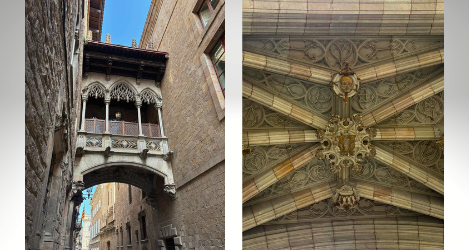
The Pont del Bisbe was built in 1928 by Joan Rubió i Bellver, a disciple of Antoni Gaudí, during the remodeling of the Gothic Quarter for the 1929 International Exhibition. Although today it seems to have been part of the landscape for centuries, it is actually a relatively recent addition.
Most visitors limit themselves to photographing it from the center of the street. However, there is a hidden detail that often goes unnoticed: under the bridge, one can see a small skull pierced by a dagger.
Popular legend claims that whoever looks at this symbol will suffer bad luck. Others say that whoever does not find it will never come to know the true Barcelona. As is the case with many stories of the old town, nobody knows exactly where reality ends and legend begins.
To photograph this corner, we recommend visiting it first thing in the morning. Between seven and eight-thirty, the street remains quiet, and the side light highlights the ornamental details of the stone. It is also the best time to capture an image without crowds.
Barcelona before waking up
If there is a magical hour in the Gothic Quarter, it is just before the city wakes up. As cafes begin to prepare the first breakfasts and shops slowly raise their shutters, the streets retain a calm that disappears a few hours later.
Carrer del Bisbe is one of the best places to experience this moment. The street lamps are still on, the stone retains the humidity of the night, and the silence allows you to appreciate details that normally go unnoticed.
Many photographers consider this instant the best of the day to capture the essence of the old town. There is no rush, there is no noise, and the city seems to belong only to those who rise early.
Plaça Sant Felip Neri: a square that moves you
It is difficult to find a place that gathers so much beauty and such emotional weight in so few square meters.
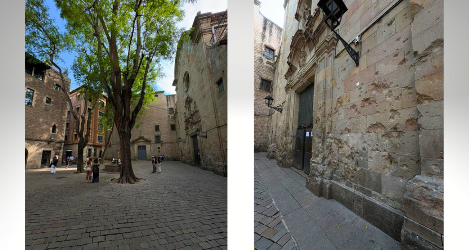
Hidden among narrow alleys, Plaça Sant Felip Neri often surprises those who discover it for the first time. Its central fountain, the baroque church, and the silence that envelops it create an almost magical atmosphere.
But you only need to get close to the facade to discover the scars that still remain visible on the stone.
The impacts covering the wall are the result of a bombing that occurred on January 30, 1938, during the Spanish Civil War. A bomb dropped by the Italian air force caused the death of dozens of people, among them numerous children who were taking refuge in the area.
The marks remain visible as a tribute and reminder. They are one of the most striking images of the Gothic Quarter and remind us that the history of Barcelona is not only made up of great monuments, but also of difficult moments that have marked several generations.
The square changes completely depending on the time of day. In the morning, it conveys serenity; at noon, it fills with light; and as evening falls, it acquires an intimate atmosphere that invites you to sit for a few minutes and simply observe.
Plaça del Rei and the medieval heart of Barcelona
Crossing Plaça del Rei, it is easy to imagine the Barcelona of six hundred years ago. This space was one of the most important political centers of the Crown of Aragon and still retains an extraordinarily medieval atmosphere.
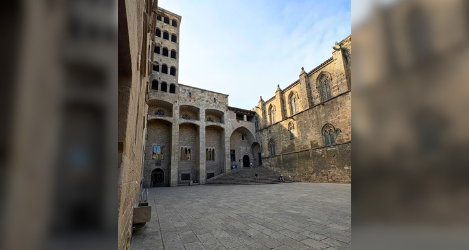
Here you can find some of the most important historical buildings in the city, but the best discoveries are usually found far from the center of the square.
The side arches, stone stairs, shadows cast by the buildings, and less obvious perspectives offer some of the most evocative photographs of the Gothic Quarter.
During the golden hour, when golden light illuminates the facades, the whole area acquires a spectacular beauty. It is no coincidence that this space has served as a setting for films, documentaries, and historical productions.
The Cathedral that almost no one photographs
Barcelona Cathedral is one of the most visited monuments in the city. Every day, thousands of people stop in front of its spectacular main facade to take the classic photograph that appears in practically every travel guide.
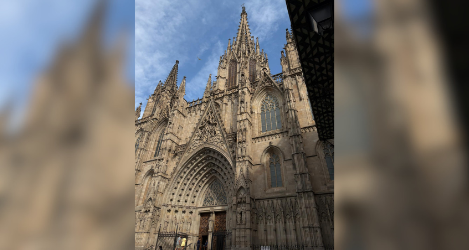
However, some of the most fascinating corners of the building are found precisely where most visitors do not look.
When you go around the Cathedral, the atmosphere changes completely. The crowds disappear, and architectural details begin to appear that tell a much richer story than the most well-known frontal image. Centuries-old gargoyles, monumental buttresses, Gothic pinnacles, and plays of shadows on the stone reveal the extraordinary complexity of a building whose construction lasted for centuries.
It is especially interesting to observe how light transforms these spaces throughout the day. During the early morning hours, the side facades receive a soft illumination that highlights the textures of the stone. At sunset, the shadows cast by the architectural elements create almost theatrical compositions that seem taken from another era.
For photography lovers, this is one of the most rewarding places in the Gothic Quarter. You don't need to photograph the whole Cathedral. Sometimes it is enough to isolate a gargoyle, follow the line of a shadow, or look for the contrast between the century-old stone and the golden light of Barcelona.
These are images that show a different perspective of the monument and allow you to discover details that go unnoticed by most visitors.
The oldest shop in Barcelona and the value of traditions
In a city in constant transformation, finding businesses that have survived for centuries is almost miraculous. One of the most extraordinary examples is found a few minutes from the Cathedral, on the Baixada de la Llibreteria.
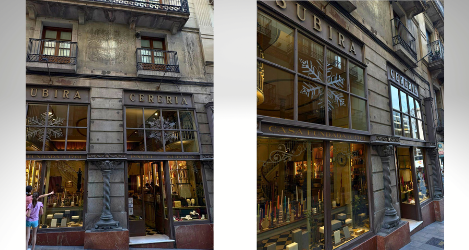
There we find Cereria Subirà, considered one of the oldest commercial establishments in Barcelona and a true city institution. Its origins date back to the 18th century, when lighting still depended on candles and artisanal trades were an essential part of daily life.
Entering the shop is like opening a small door to the past. The scent of wax, the shelves filled with candles of all sizes, the warm lighting, and the decorative details create an atmosphere that seems to resist the passage of time.
Beyond the facade photograph, what is truly interesting is found in the small details: the textures, the colors, the reflections of light, and the feeling of being in a place where tradition is still alive.
In an era dominated by large international chains and businesses increasingly similar to each other, places like Cereria Subirà remind us of the importance of preserving local identity and the commercial heritage of the city.
It is also one of those corners that usually surprise those who are looking for a different Barcelona, far from the most common routes and much more connected to the daily history of its inhabitants.
And there are still many secrets to discover...
One of the greatest virtues of the Gothic Quarter is that it never runs out. Even after several visits, a new detail, an unknown street, or a story we had overlooked always appears.
One of those places that deserves a quiet stop is the cloister of the Barcelona Cathedral. While the exterior receives thousands of visitors every day, this space remains surprisingly serene. Among gardens, Gothic columns, and century-old fountains live the famous thirteen white geese that, according to tradition, represent the age of Saint Eulalia when she was martyred. The contrast between the bustle of the city and the calm of the cloister is almost magical.
Very close by is also the small Carrer del Paradís, where four Roman columns of the ancient Temple of Augustus are preserved. It is one of the most important vestiges of the ancient Barcino, yet many visitors pass by just a few meters away without knowing they are next to a construction with more than two thousand years of history.
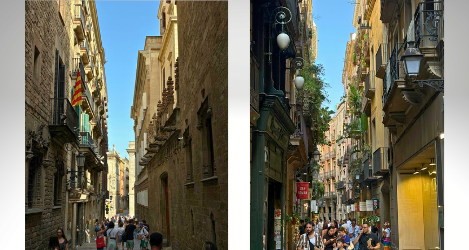
Another corner full of charm is Carrer de Petritxol. This narrow pedestrian street is famous for its art galleries, ceramic plaques, and its historic cafes where you can taste hot chocolate with churros. Although it is just a few steps from the busiest areas, it retains a quiet atmosphere that invites you to walk without hurry.
It is also worth stopping at the small interior courtyards, discreet passages, and hidden squares that appear unexpectedly among the medieval streets. Many do not appear in tourist guides, but that is precisely where part of their charm lies.
Because the Gothic Quarter is not a place to be visited with a fixed list of monuments. It is a neighborhood to explore, to get lost in, and to let the city reveal its secrets little by little.
Special thanks: Photography R.A.F.G.