Une promenade à travers les mosaïques de Barcelone
Culture30/06/2026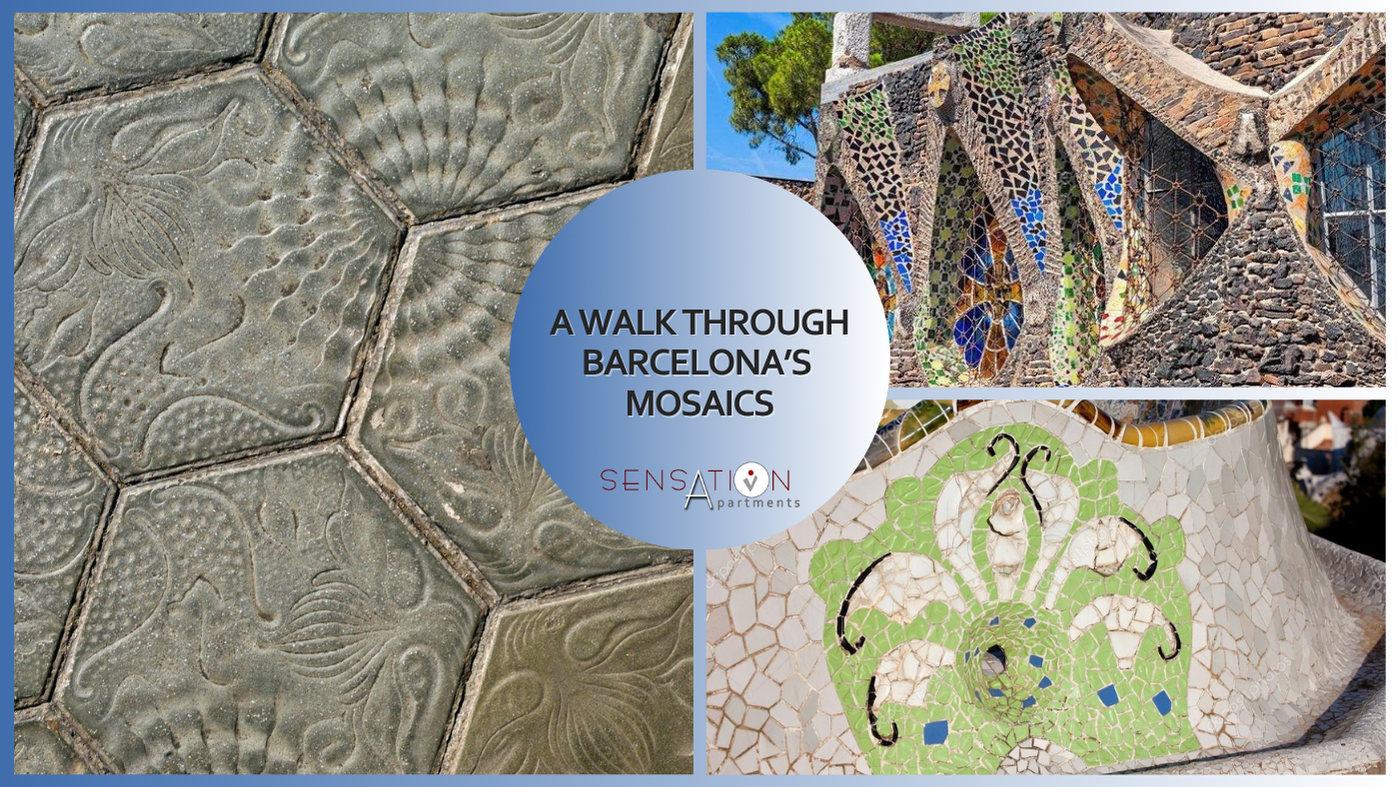
But while we admire everything that rises above us, we often overlook an equally fascinating part of the city.
Every day, we walk on stone flowers, centuries-old mosaics, designs inspired by the Mediterranean, and small works of art that have been part of Barcelona's urban landscape for over a hundred years. Most people walk over them without realizing it. However, once you discover them, it's impossible to experience the city in the same way again.
Today, we propose a very simple game: for the next few minutes, forget about looking up and join us in discovering the Barcelona that hides beneath your feet.
Start by looking at the ground: the panot, the little icon of Barcelona
If you've ever walked through the Eixample, you've surely seen it hundreds of times. A discreet, square, gray tile with a four-petal flower in the center. It's the famous panot de flor, also known as the Flower of Barcelona.
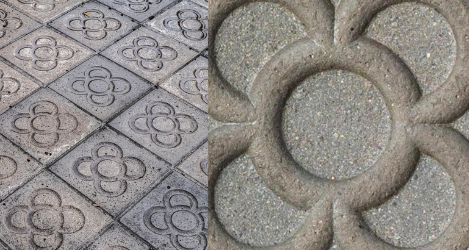
The curious thing is that something so everyday has become one of the city's most recognizable symbols. It appears on souvenirs, jewelry, t-shirts, decorative prints, and design objects. But before it was an icon, it was a practical solution.
At the beginning of the 20th century, Barcelona needed to organize its sidewalks. The growth of the Eixample had brought new streets, new buildings, and also problems of mud, dust, and uneven pavements. In 1906, the City Council promoted the standardization of several tile models to pave the city. Among them was the panot de flor, which over time would become the most loved and recognizable.
Its design is associated with Josep Puig i Cadafalch and Casa Amatller, where we find a precedent for this flower at the entrance to the building. What's fascinating is how a detail born to solve an urban problem ended up becoming part of Barcelona's visual identity.
The panot doesn't compete with the great monuments. It simply accompanies the city's daily life. It's stepped on by locals going to the market, children leaving school, travelers dragging suitcases, and couples wandering aimlessly through the Eixample.
And perhaps that's why we like it so much: because it's Barcelona in its most everyday version.
Now, step inside the buildings: hydraulic mosaics
If the panot belongs to the street, the hydraulic mosaic belongs to the intimacy of homes.
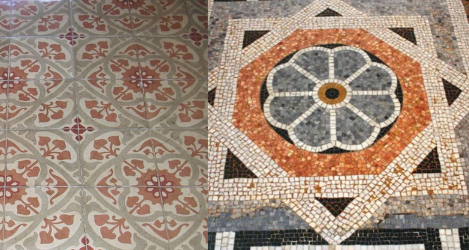
For decades, especially between the late 19th and early 20th centuries, hydraulic floors were the stars in many Barcelona homes. In the modernist apartments of the Eixample, each room could have its own design: floral motifs, geometric shapes, vegetal compositions, borders, and colors that turned the floor into a genuine permanent carpet.
These mosaics were not fired like traditional ceramics. They were made using molds, pigments, and hydraulic pressing, a technique that allowed for the creation of resistant, decorative pieces highly valued by the bourgeoisie of the time.
The beauty of these floors is that they were not meant to be observed from afar. They were enjoyed by living on them.
In many old buildings in Barcelona, you can still see them when you cross a doorway, go up a staircase, or discreetly look into a lobby. Some are perfectly restored. Others show the natural wear and tear of time. And that's part of their charm.
An old hydraulic mosaic doesn't just speak of design. It speaks of a way of inhabiting the city, of an era when beauty was not reserved solely for facades but entered the homes themselves.
Look up a little… but only as far as Passeig de Gràcia
There is a place in Barcelona where looking at the ground becomes almost an obligation: Passeig de Gràcia.
While most visitors walk along this avenue looking for Casa Batlló, La Pedrera, or the luxury shop windows, beneath their feet lies one of Antoni Gaudí's most elegant designs: the hexagonal pavement.
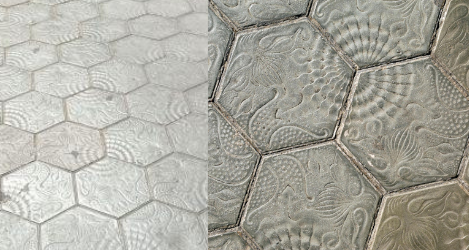
This mosaic was designed by Gaudí in 1904 for Casa Batlló, although it was eventually placed in Casa Milà. Years later, Barcelona recovered it as a tribute to the architect and installed it on the sidewalks of Passeig de Gràcia.
At first glance, it may seem like an abstract drawing, but if you stop for a moment, you'll discover that Gaudí created a small marine universe. In its shapes, you'll find a starfish, an ammonite, and seaweed, three motifs inspired by nature and the Mediterranean.
As is often the case with Gaudí, nothing is accidental.
The pavement of Passeig de Gràcia is not just beautiful. It's a lesson in design, nature, and geometric repetition. Each piece needs the others to complete the drawing, as if the entire city were participating in an infinite composition.
Next time you pass by, try it. Stop for a few seconds. Look for the shapes. Follow the lines. Suddenly, a simple sidewalk becomes a modernist seabed.
Look at the walls: trencadís and the art of recomposing the broken
Barcelona doesn't just have mosaics on the ground. It also has them on benches, facades, chimneys, domes, and walls.
Here comes into play one of the most recognizable techniques of Catalan modernism: trencadís.
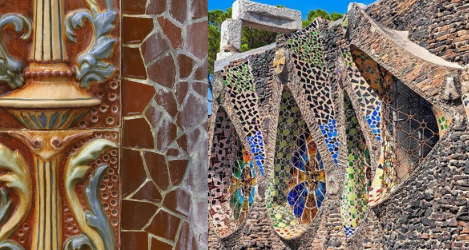
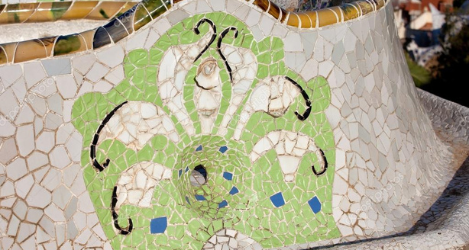
Trencadís consists of creating decorative compositions with irregular fragments of ceramic, tiles, glass, or broken plates. Instead of hiding the break, it turns it into beauty. It is a deeply Mediterranean, colorful, and lively technique, particularly associated with Antoni Gaudí and Josep Maria Jujol.
The most famous example is in Park Güell, where the undulating benches, the staircase, and the famous salamander show the extent to which trencadís can transform a surface into an explosion of color.
But you don't have to limit yourself to Park Güell. We also find this technique in other modernist spaces in the city, in details of facades, courtyards, chimneys, and decorative elements that often go unnoticed.
Trencadís is a way of looking at matter differently: what is broken is not discarded, it is reorganized. And perhaps that's why it's so poetic.
Look at the modernist buildings: Sant Pau and mosaics as narrative
A few minutes from the Sagrada Familia is one of Barcelona's most impressive modernist complexes: the Recinte Modernista de Sant Pau.
The former hospital, designed by Lluís Domènech i Montaner, combines brick, stone, ceramic, glass, sculpture, and mosaic in a complex designed to be functional, bright, and profoundly human.
On its facades and pavilions, we find mosaics that narrate scenes, symbols, and stories linked to the institution. Sant Pau is one of those places where it's advisable to walk slowly. It's not enough to look at the building as a whole. You have to get closer, observe the details, pay attention to the inscriptions, the colors, and the small ceramic elements that decorate its walls.
For those staying near the Sagrada Familia, it's also a particularly convenient visit. Gaudí Avenue connects the two monuments with a pleasant walk, full of terraces, neighborhood life, and beautiful views.
If Sant Pau uses mosaics to tell stories, the Palau de la Música Catalana uses them to create emotion.
Also designed by Lluís Domènech i Montaner, the Palau is one of the jewels of Catalan modernism and one of Barcelona's most exuberant buildings. Here, everything seems to sing: the columns, the stained glass, the sculptures, the ceramic flowers, and the mosaics.
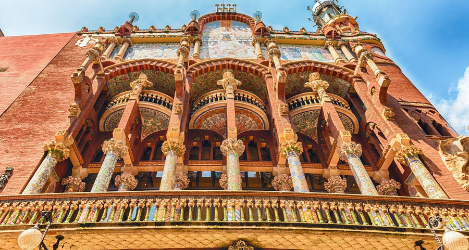
On its facade and in its interiors, mosaic mixes with other materials to create a sense of constant movement. There is no surface that is completely still. Everything vibrates, everything shines, everything seems to be part of a great musical composition.
Therefore, even if you don't go in for a concert, it's worth approaching and calmly observing its facade.
Look at the doorways: the hidden mosaics of the Eixample
One of the most beautiful ways to discover mosaics in Barcelona is to pay attention to the doorways.
In the Eixample, many buildings retain modernist lobbies with hydraulic floors, ceramic wainscoting, stained glass, noble staircases, and small decorative details that are barely visible from the street.
You can't always enter, of course. These are private buildings, and it's important to be respectful. But often, from the doorway or the lobby glass, you can glimpse an interior world full of color and design.
Casa Amatller, located next to Casa Batlló on Passeig de Gràcia, is one of Barcelona's most special buildings.
Designed by Josep Puig i Cadafalch, it combines Gothic, Flemish, and modernist influences in an unmistakable facade. But one of its most interesting details is found on the floor of the entrance.
There appears a four-petal flower that many associate with the origin of Barcelona's famous panot de flor. Although the panot eventually gained a life of its own on the city's sidewalks, it's fascinating to think that one of Barcelona's most popular symbols is related to such an elegant building on Passeig de Gràcia.
It's a perfect example of how ideas travel. What was initially part of the entrance to a bourgeois house ended up becoming an image that today represents the entire city.
Next time you leave our apartments to explore Barcelona, try changing the way you look at the city.
Look up to admire the Sagrada Familia. Then look down again. Perhaps you'll discover that some of Barcelona's greatest treasures are not on the facades, but right under your feet.
And don't miss this interesting article about the history of the panot.